

Top 14 Pagodas In Hoi An: Must-Visit Temples For Culture, History & Peaceful Moments
Hoi An pagoda trails reveal a quieter side of the Ancient Town, beyond merchant houses, lantern streets, and riverfront cafés. UNESCO describes Hội An as a preserved trading port with religious buildings, including pagodas and family cult houses, so these sacred sites are part of the city’s living heritage rather than simple sightseeing stops.
This guide turns the city’s temples, shrines, and communal houses into a calm cultural route. After incense-scented halls, carved altars, and shaded courtyards, La Siesta Hoi An Resort & Spa becomes a restorative green base just minutes from the Ancient Town.
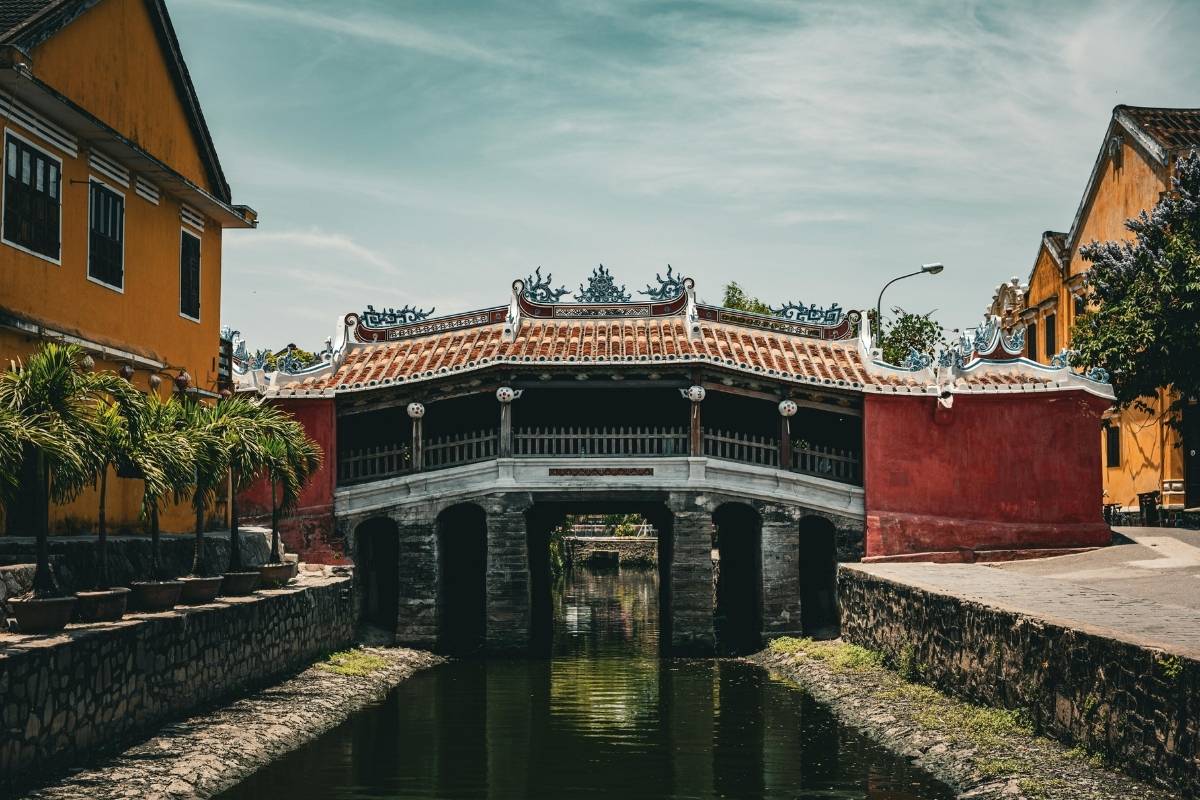
Japanese Covered Bridge (Chùa Cầu)
- Location: Nguyen Thi Minh Khai, Minh An Ward, Hoi An, Da Nang
- Year built: Late 16th – early 17th century.
- Architectural highlights: A rare “thượng gia hạ kiều” design – literally a house above and bridge below – with a wooden superstructure, stone supports, yin-yang roof tiles, an attached shrine, and guardian dog and monkey statues at the ends.
- Religious significance: The bridge includes a shrine to Bắc Đế Trấn Vũ – also called Huyền Thiên Đại Đế – a deity linked with protection from water and natural hazards. It also stands as a symbol of Japanese, Chinese, and Vietnamese spiritual exchange in old Hội An.
Japanese Covered Bridge is Hoi An’s most symbolic sacred structure because it combines a bridge, a covered house, and a shrine in one compact monument. The bridge was built around the late 16th to early 17th century, while the shrine to Bắc Đế Trấn Vũ was added in 1653 to protect the riverside town from floods and natural hazards.
Visit early in the morning if you want to see the carved timber frame without the heaviest Old Town crowd. Because the bridge is narrow and highly photographed, it is better to pause at both ends, notice the dog and monkey guardians, then step inside quietly to understand its Japanese, Chinese, and Vietnamese spiritual exchange.
Phap Bao Pagoda (Chùa Pháp Bảo)
- Location: V8HG+CPQ, Phan Chu Trinh Street, Minh An Ward, Hoi An, Da Nang, Vietnam
- Year built: 1936.
- Architectural highlights: The pagoda has been renovated several times but still keeps an old-style pagoda character. Inside, the main hall places Shakyamuni Buddha at the center, with Amitabha and Maitreya on either side, plus side altars for Avalokiteshvara and Mahasthamaprapta.
- Religious significance: Pháp Bảo began as the provincial Buddhist association pagoda for Quảng Nam, was renamed in 1967, and today serves as a key Buddhist center in Hội An, hosting major rites such as Vesak, Thành Đạo, and Vu Lan.
Phap Bao Pagoda is one of the most accessible Buddhist sites in central Hoi An because it sits close to the Ancient Town while keeping a quieter temple rhythm. The main hall places Shakyamuni Buddha at the center, with Amitabha Buddha and Maitreya Buddha nearby, while side altars honor Avalokiteshvara and Mahasthamaprapta.
This is a valuable stop if you want a simple introduction to Bắc Tông Buddhist worship in Hoi An. Come during a non-ceremony period for quiet observation, or visit respectfully around major Buddhist occasions such as Vesak, Vu Lan, and Thành Đạo, when the pagoda’s community role becomes more visible.
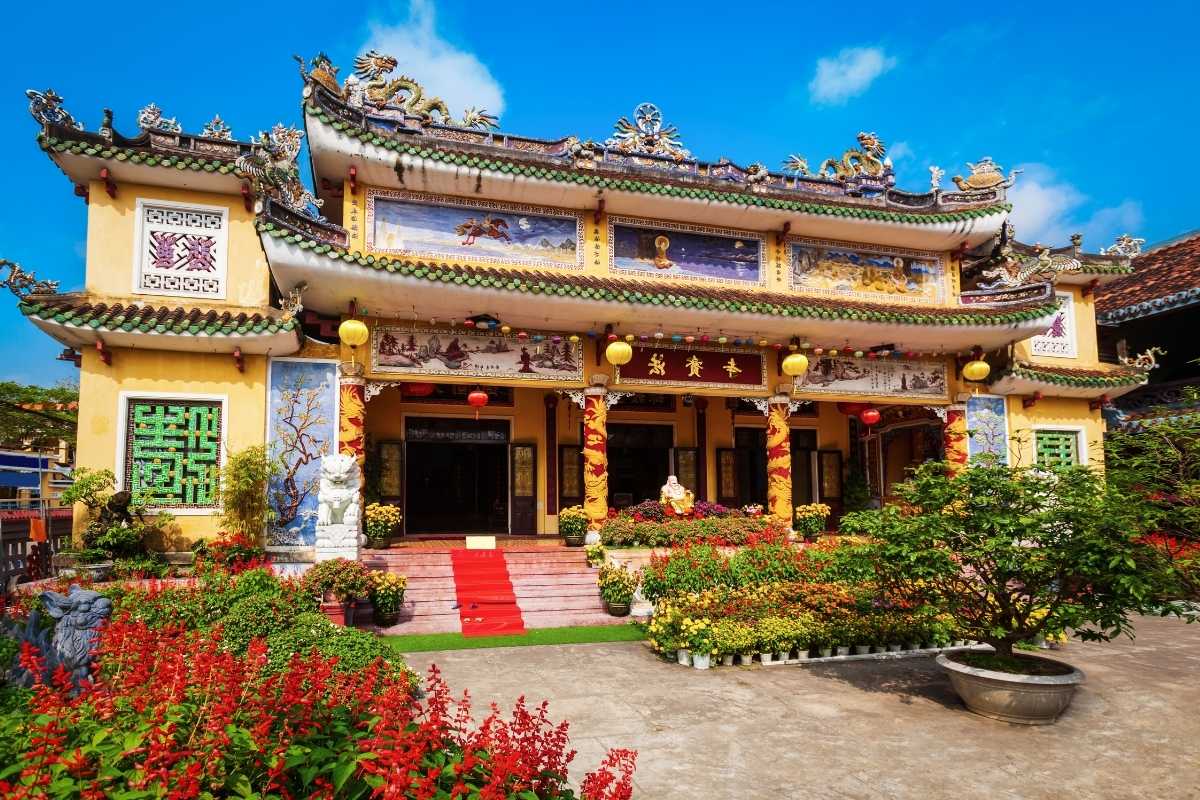
Van Duc Pagoda (Chùa Vạn Đức)
- Location: W83C+RPV, Hoi An Tay, Da Nang, Vietnam
- Year built: Late 17th – early 18th century.
- Architectural highlights: The pagoda’s layout reflects different historical building phases. Later descriptions note a U-shaped plan, yin-yang tiled roofs, and ridge decorations with dragons, lions, turtles, and phoenixes. It also preserves valuable statues, relics, and historic woodblocks.
- Religious significance: Vạn Đức is one of the three main ancestral pagodas of the Lâm Tế Chúc Thánh Zen lineage in Hội An, and it preserves materials tied to the spread of Buddhism in Hội An and Đàng Trong.
Van Duc Pagoda rewards travelers who want to move beyond the Old Town and see Hoi An’s quieter Buddhist countryside. The pagoda belongs to the Lâm Tế Chúc Thánh network, and heritage sources identify Chúc Thánh, Vạn Đức, and Phước Lâm as three principal ancestral pagodas of this lineage in Hoi An.
The best experience here is slow looking rather than quick sightseeing. Because the site preserves statues, relics, and historic woodblocks, you should give yourself enough time to notice roof ornaments, timber details, and the calm spatial layout instead of treating it as a photo stop.
Ong Pagoda (Chùa Ông)
- Location: 24 Tran Phu, Old Town, Hoi An, Da Nang, Vietnam
- Year built: Early 17th century.
- Architectural highlights: The temple follows a “chữ khẩu” layout with a front hall, main sanctuary, and side wings. It has thick brick walls, a heavy timber roof frame, yin-yang roof tiles, ceramic decoration, and a strong sculptural program centered on Guan Yu, Quan Bình, Châu Xương, and the Red Hare and White Horse.
- Religious significance: Chùa Ông is dedicated to Quan Công – Guan Yu – who is revered as a model of loyalty and righteousness.
Ong Pagoda sits in the heart of the Old Town and gives travelers a direct look at Hoi An’s Chinese community heritage. The temple, also known as Quan Cong Temple, was established by Chinese immigrants in 1653 and worships Guan Yu, the Three Kingdoms general revered for loyalty, integrity, and justice.
This temple is best visited slowly because the interior is dense with symbolic figures, incense, ceramic ornament, and carved timber. Since it sits on busy Tran Phu Street, go early or late afternoon, then pair it with nearby assembly halls and old merchant houses for a compact cultural walk.
Nam Ton Pagoda (Nam Tôn Phật Đường)
- Location: V8HR+WMM, Hoi An Dong, Da Nang, Vietnam
- Year built: 1936.
- Architectural highlights: The complex has a three-gate entrance, a 1,000-square-meter compound, and a main hall in a “tiền đường hậu điện” arrangement. It uses yin-yang roof tiles, dragon and kylin ornament, carved timber elements, and also includes some French-style ancillary buildings with arched openings.
- Religious significance: Nam Tôn Phật Đường belongs to Minh Sư Đạo, a syncretic tradition rather than standard Buddhist monastic Buddhism. Its worship combines elements of Confucianism, Buddhism, and Taoism, including the Jade Emperor, Diêu Trì Kim Mẫu, Shakyamuni Buddha, Confucius, and Laozi.
Nam Ton Phật Đường is valuable because it shows that Hoi An’s sacred landscape extends beyond standard Buddhist monasteries. The site was built by Minh Sư Đạo followers in 1936, covers about 1,000 square meters, and faces southeast, according to Hoi An heritage records.
This is a meaningful stop for travelers interested in syncretic worship. Instead of expecting a typical Buddhist pagoda, look for a layered spiritual system where the Jade Emperor, Diêu Trì Kim Mẫu, Shakyamuni Buddha, Confucius, and Laozi reflect the meeting point of Buddhism, Taoism, and Confucian ethics.
Quan Cong Temple (Miếu Quan Công)
- Location: 24 Tran Phu, Cam Chau, Hoi An, Da Nang, Vietnam
- Year built: Around 1653, based on the 1753 stele
- Architectural highlights: Its present form was largely shaped by 19th-century restoration. The temple keeps a chữ-khẩu plan, an imposing timber roof frame, brick walls, yin-yang tiles, ceramic ornament, and a richly carved interior.
- Religious significance: The temple is one of Hội An’s best-known Chinese community shrines, honoring Quan Công as the embodiment of loyalty, justice, and integrity.
Quan Cong Temple is one of Hoi An’s clearest examples of Chinese spiritual architecture inside the Ancient Town. Built in 1653, the temple honors Guan Yu, and several sources describe it as one of Hoi An’s best-known religious sites tied to Chinese immigrant communities.
The site is most rewarding when you read it as both shrine and moral symbol. Because merchants historically valued Quan Công as an embodiment of trust and righteousness, the carved interior, red-and-gold altar tones, and incense-filled sanctuary help explain how commerce and faith once supported each other in old Hoi An.
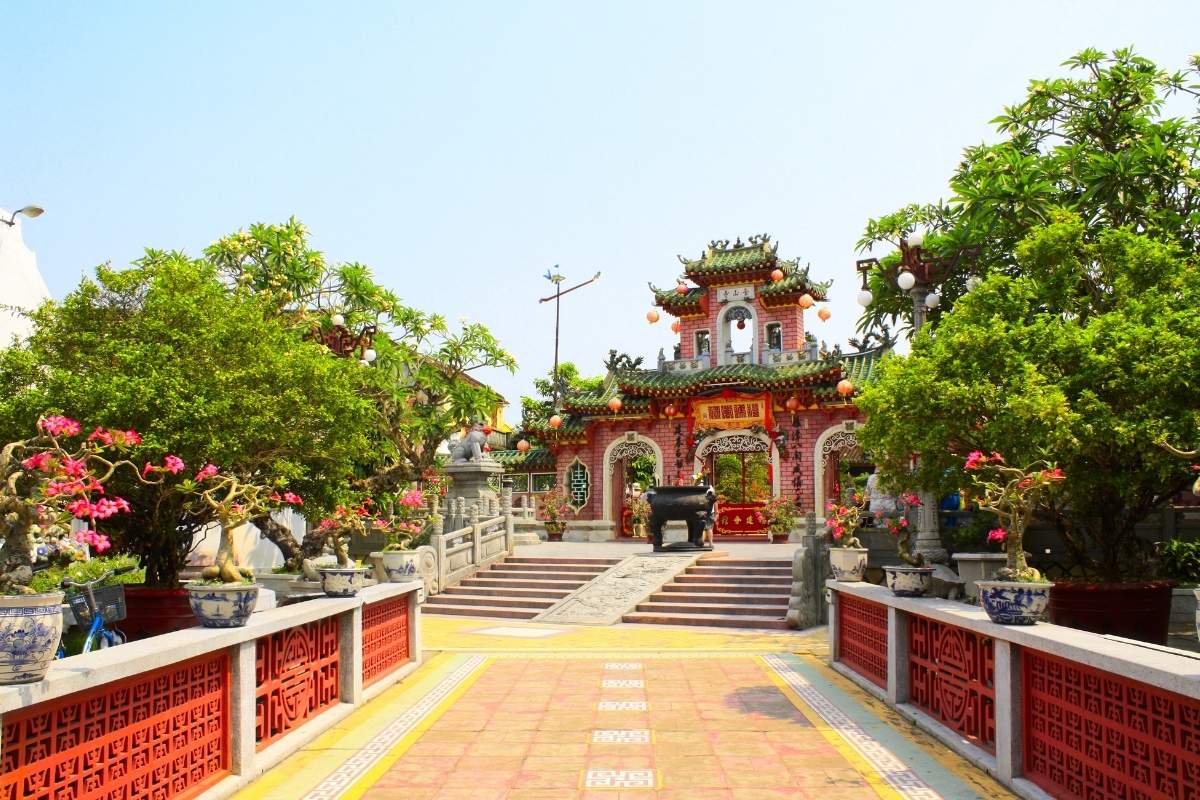
Chuc Thanh Pagoda (Chùa Chúc Thánh)
- Location: V8QG+CJF, Area 7, Hoi An Tay, Da Nang, Vietnam
- Year built: Late 17th – early 18th century.
- Architectural highlights: Chúc Thánh uses a “tiền công hậu quốc” layout and combines Chinese-style “chồng rường giả thủ” carpentry with Vietnamese-style “cột trốn kẻ chuyền” framing.
- Religious significance: This is the root monastery of the Lâm Tế Chúc Thánh Zen lineage in Đàng Trong. From here, the lineage spread widely across central and southern Vietnam and overseas, which makes the pagoda one of Hội An’s most important Buddhist heritage sites.
Chuc Thanh Pagoda is one of the most important Hoi An pagoda sites for Buddhist history. Heritage sources state that Zen Master Minh Hải – Pháp Bảo founded the Lâm Tế Chúc Thánh lineage in Hoi An in the late 17th century, making Chúc Thánh the root monastery of a tradition that spread widely through central and southern Vietnam.
This pagoda is especially valuable for travelers who want depth rather than decoration alone. Arrive by bicycle from the Old Town, walk slowly through the quiet compound, and pay attention to the blend of Chinese and Vietnamese wooden structures, because the architecture reflects the same cultural fusion that shaped Hoi An itself.
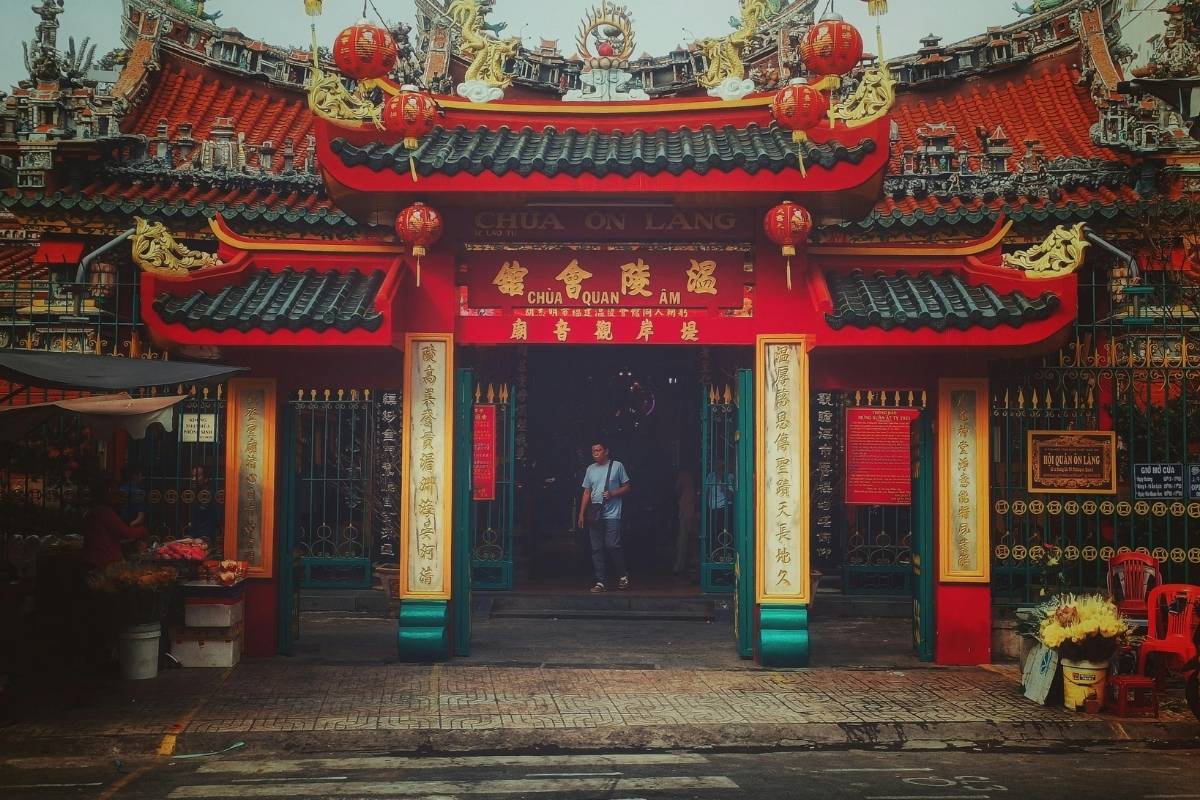
Quan Am Pagoda (Quan Âm Phật Tự / Minh Hương Phật Tự)
- Location: 13 Nguyen Hue Street, Minh An Ward, Hoi An
- Year built: Around 1653 at the latest, or broadly the 17th century.
- Architectural highlights: The complex includes a simple four-pillar tam quan with lotus-bud finials, a small forecourt, and a three-bay main hall with a wooden frame, brick walls, and yin-yang roof tiles. The gate is notable for its Hán inscriptions and couplets, while the main hall keeps a restrained, elegant old-town scale.
- Religious significance: Built by the Minh Hương community to worship Avalokiteshvara, the pagoda has long been one of Hội An’s key Buddhist sites.
Quan Am Pagoda is a compact but historically rich site linked to the Minh Hương community. Hoi An heritage records describe the pagoda as a 17th-century site dedicated to Quan Âm, with a simple four-pillar gate, lotus-bud finials, a forecourt, and a main hall set within the Old Town fabric.
This is a good stop when you want a quieter pause near major attractions. Because the pagoda scale is restrained, look closely at the Hán inscriptions, old wooden frame, and altar arrangement rather than expecting a large complex; the value is in intimacy, age, and continuity of worship.
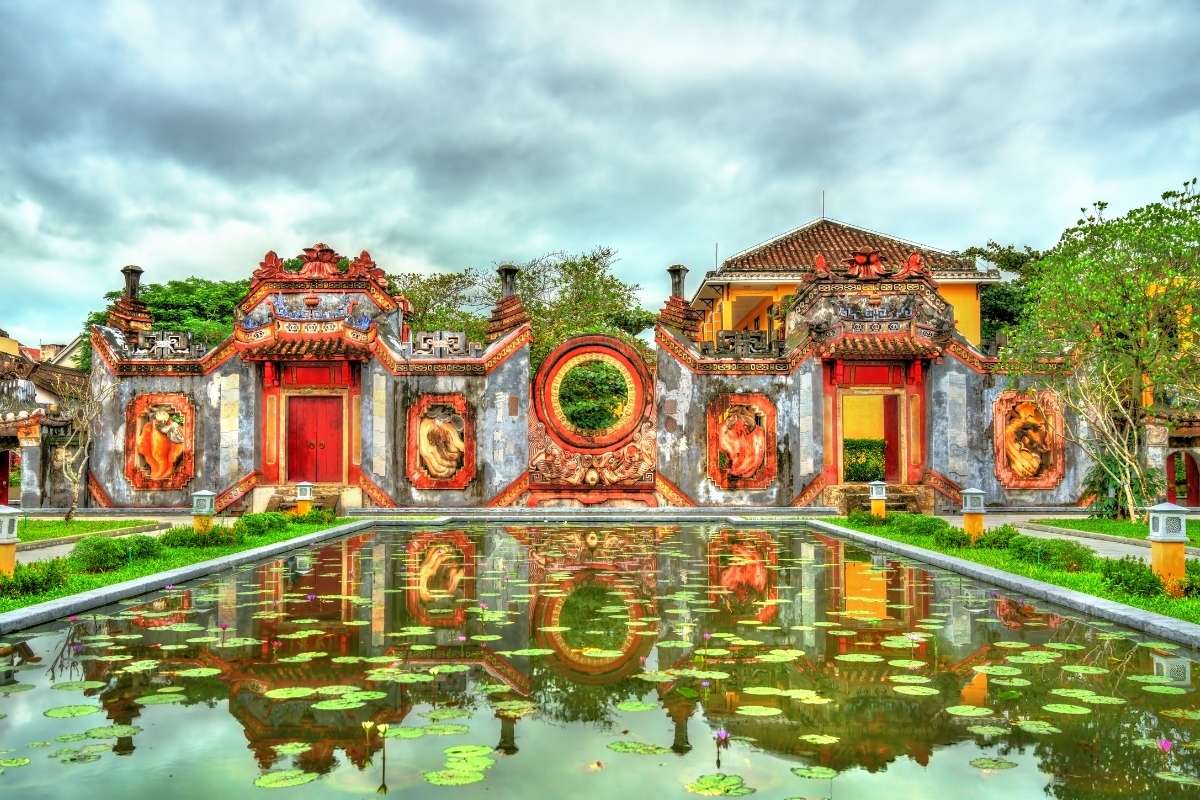
Ba Mu Pagoda (Chùa Bà Mụ)
- Location: 675 Hai Ba Trung, Old Town, Hoi An, Da Nang, Vietnam
- Year built: 1626 for the original Cẩm Hà Cung – Hải Bình Cung complex. The surviving gate also records major restorations in 1848 and 1922.
- Architectural highlights: What remains today is the distinctive tam quan gate, facing southwest, with a rare twin-gate composition from two original shrines joined into one façade. Key details include a circular moon motif at the center, paired lân figures, scroll-shaped overall composition, decorative panels, ponds in front, and dense Hán calligraphy worked into the structure.
- Religious significance: This was not a standard Buddhist pagoda. Cẩm Hà Cung worshipped Bảo Sanh Đại Đế and attendant generals, while Hải Bình Cung worshipped Thiên Hậu and the 12 Bà Mụ or midwife deities, making the site important to Minh Hương folk religion, fertility belief, and community ritual life.
Ba Mu Pagoda is not a standard Buddhist pagoda, and that difference makes it one of Hoi An’s most distinctive sacred stops. Heritage sources explain that the original Cẩm Hải Nhị Cung consisted of two worship spaces: Cẩm Hà Cung for Bảo Sanh Đại Đế and Hải Bình Cung for Thiên Hậu and the 12 midwife deities.
The surviving Tam Quan Gate is especially valuable for photography, but it deserves more than a quick picture. Visit in the early morning or late afternoon, when the ponds and moon-shaped motif are easier to appreciate, then read the site as a window into fertility belief, community ritual, and Minh Hương folk religion.
Phuoc Lam Pagoda (Chùa Phước Lâm)
- Location: V8RF+XC9, Le Hong Phong Street, Cam Ha, Hoi An Tay, Da Nang, Vietnam
- Year built: Early 18th century.
- Architectural highlights: The pagoda has a brick tam quan, old shade trees, a large scroll-shaped screen with a moon opening, east and west stele houses, and a main complex laid out in the chữ môn form. The main hall has bell lofts at both ends, chồng diêm roofing, curved tàu đao gables, yin-yang tiles, and ceramic dragon, phoenix, and kylin ornament.
- Religious significance: Phước Lâm is an important monastery of the Lâm Tế – Chúc Thánh lineage. It was founded by Minh Giác, a disciple of Minh Hải – Pháp Bảo.
Phuoc Lam Pagoda is one of the key ancestral sites of the Lâm Tế Chúc Thánh tradition in Hoi An. Heritage research groups Phước Lâm with Chúc Thánh and Vạn Đức among the three main ancestral pagodas of this lineage, which gives the site strong religious and historical weight.
This pagoda is best experienced as a peaceful architectural walk. The old shade trees, brick gate, stele houses, bell lofts, curved roof edges, and ceramic dragons reward slow observation, while the quieter location makes it a good choice for travelers who want a reflective pause outside the busiest streets.
Cam Pho Communal House (Đình Cẩm Phô)
- Location: 52 Nguyen Thi Minh Khai, Minh An Ward, Hoi An, Da Nang, Vietnam
- Year built: Exact founding year unknown.
- Architectural highlights: The communal house has a chữ quốc layout with a four-roofed pavilion in front, east and west wings, and a broad main sanctuary. Heritage records highlight the ridge decoration, gable ornament, and roof creatures as especially fine examples in the area.
- Religious significance: This is not a Buddhist pagoda but the ritual center of old Cẩm Phô village. It originally worshipped the Thành Hoàng and protective village deities, and later also honored the Tiền Hiền and Hậu Hiền ancestors of the community.
Cam Pho Communal House is not a Buddhist pagoda, yet it belongs naturally in a spiritual Hoi An trail because it preserves village ritual life. The site served the old Cẩm Phô village as a communal religious center, where protective village deities and community ancestors were honored.
Its value lies in showing how Hoi An’s sacred spaces were not limited to monks and temples. Visit quietly, notice the roof creatures and broad sanctuary, then pair it with the nearby Japanese Covered Bridge, because the short walking distance helps connect village identity, urban heritage, and family-based worship in one route.
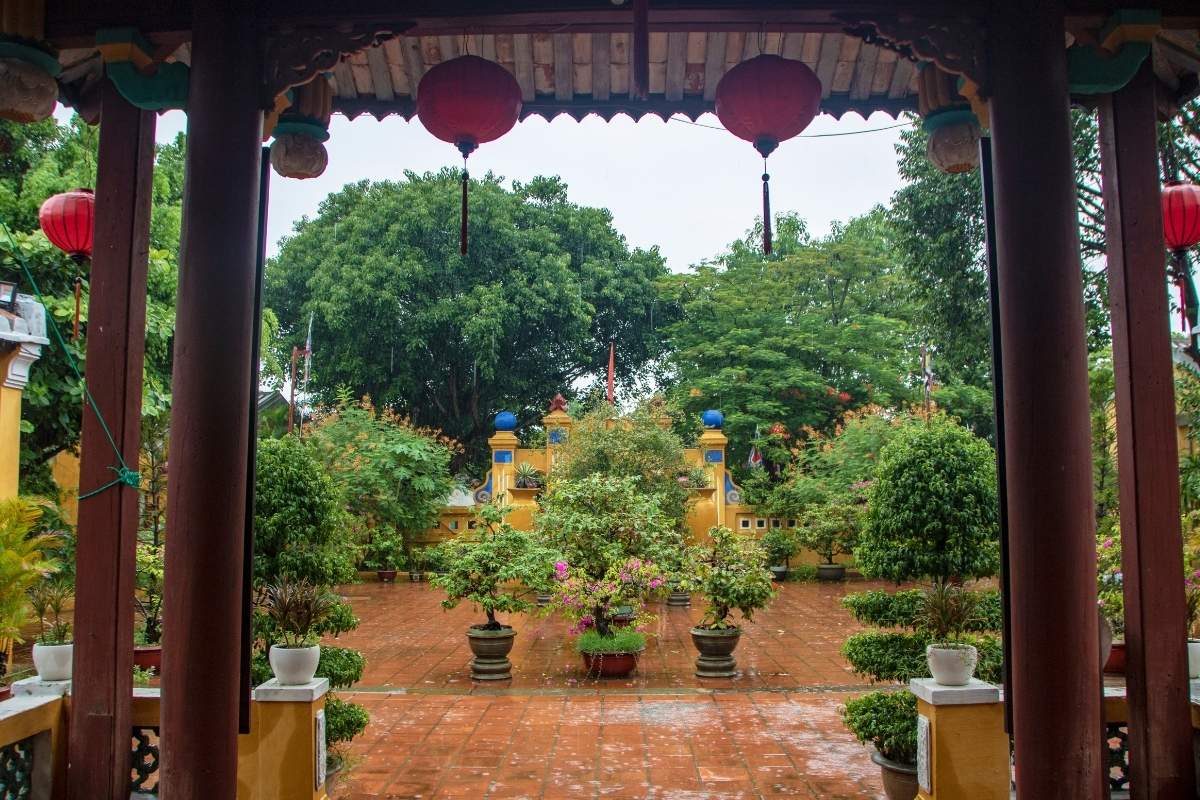
Nam Quang Pagoda (Nam Quang Tự)
- Location: 430 Cua Dai, Cam Chau, Hoi An Dong, Da Nang, Vietnam
- Year built: 1969.
- Architectural highlights: Nam Quang was rebuilt in Theravada style in the modern period. A design influenced by Thai and Cambodian Theravada architecture, with layered roofs, stupa-like motifs, and a more open compound than the older wooden pagodas in Hội An.
- Religious significance: Nam Quang is important because it represents the Theravada or Nam Tông presence in a city better known for Bắc Tông and Chúc Thánh lineage temples.
Nam Quang Pagoda stands out because it represents Theravada Buddhism in a city better known for Bắc Tông and Chúc Thánh lineage temples. Sources describe Nam Quang as established in 1969, with later renovation shaping a Thai- and Cambodian-influenced architectural style.
This pagoda is a good introduction to a different Buddhist visual language. Its open compound, large trees, solemn Buddha images, layered roofs, and stupa-like motifs create a quieter, more spacious atmosphere, so it works well for travelers who want to compare Theravada design with Hoi An’s older wooden pagodas.
Long Tuyen Pagoda (Chùa Long Tuyền)
- Location: V8P9+M67, Hoi An Tay, Da Nang, Vietnam
- Year built: 1909.
- Architectural highlights: The pagoda covers more than 1,500 square meters and faces east-southeast. It has an arched tam quan, gardens, a main axial arrangement of four buildings, and a tiền đường hậu điện main hall with yin-yang tiles, ceramic ridge ornament, and a founder’s stupa behind the main hall.
- Religious significance: Long Tuyền belongs to the Bắc Tông tradition and is one of the notable Lâm Tế Chúc Thánh pagodas in Hội An.
Long Tuyen Pagoda is a notable Bắc Tông pagoda connected with the Lâm Tế Chúc Thánh tradition. Hoi An heritage writing identifies Long Tuyền as a well-known pagoda of this lineage, located in Thanh Hà, with a religious identity tied to northern-style Mahayana practice in the local Buddhist network.
The experience here feels more local and contemplative than tourist-heavy. Because the pagoda includes an arched gate, garden setting, axial building arrangement, yin-yang tiles, and founder’s stupa, it is worth visiting when you want architecture, lineage history, and quiet reflection in one stop.
Kim Buu Pagoda (Chùa Kim Bửu)
- Location: V8C8+3CV, Hoi An, Da Nang, Vietnam
- Year built: Exact founding year is unknown
- Architectural highlights: The pagoda sits on an open riverside site and faces southeast. Key features include a large tam quan, a hexagonal forecourt with a Quan Âm statue, a three-bay two-wing plan, upper front lofts with chữ Phúc openings, a thừa lưu eave, and a cột trốn kẻ chuyền timber frame that shows the skill of Kim Bồng carpenters.
- Religious significance: Kim Bửu has long served as the village pagoda for generations of Cẩm Kim residents and preserves the traditional religious value of a Hội An village temple. It is also notable for its later revolutionary history, but in spiritual terms, it remains a core local place of Buddhist worship and community memory.
Kim Buu Pagoda is most meaningful when you connect it with Cẩm Kim and the woodworking heritage of nearby Kim Bồng village. The pagoda’s timber frame, riverside setting, Quan Âm statue, and traditional layout make it a strong stop for travelers who want to see village Buddhism beyond the Ancient Town.
The best way to visit is by bicycle or motorbike as part of a countryside loop. Because the pagoda has long served local Cẩm Kim residents, move slowly through the compound, keep your voice low, and treat the site as a living village temple rather than a decorative attraction.
Where Are the Main Pagodas Located in Hoi An?
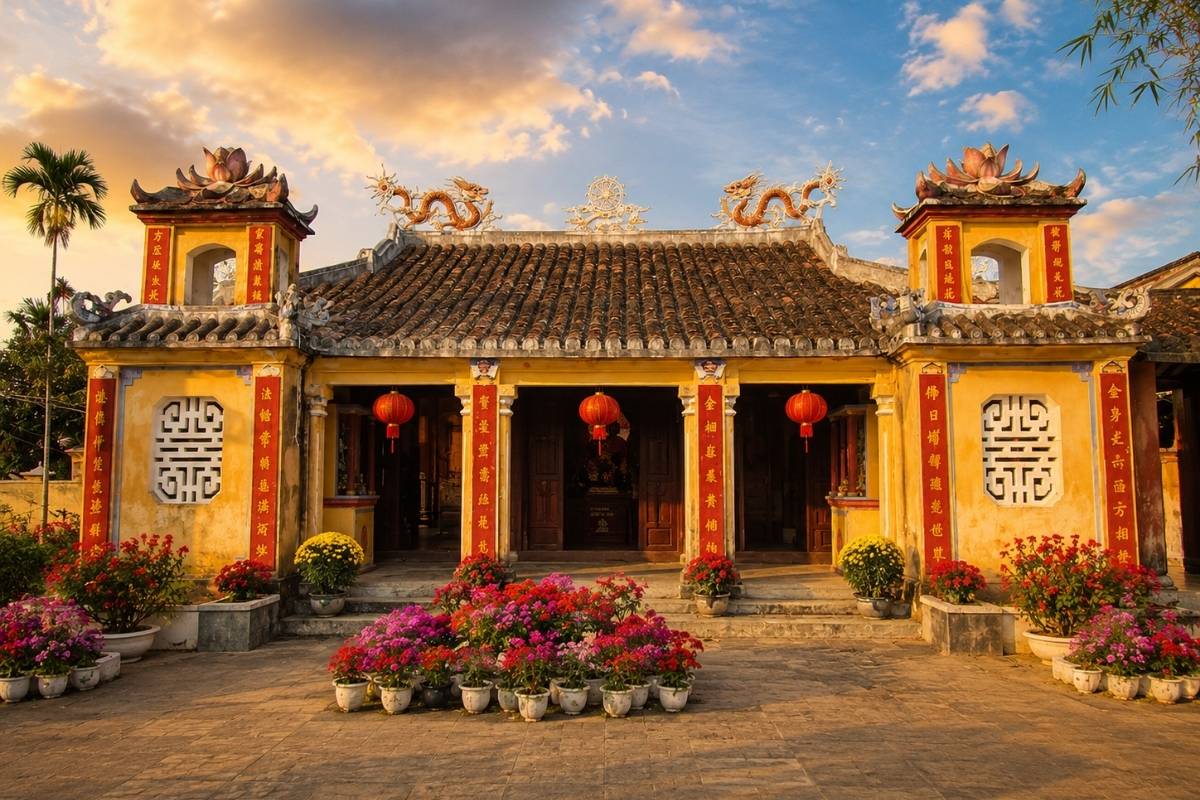
The main pagodas in Hoi An are spread across three useful zones: Old Town, the nearby outskirts, and countryside villages. Old Town sites include Japanese Covered Bridge, Quan Cong Temple, Ong Pagoda, Quan Am Pagoda, Ba Mu Pagoda, and Cam Pho Communal House, while Chuc Thanh, Phuoc Lam, Van Duc, and Long Tuyen sit farther out.
Most outer pagodas are about a 5–10 minute bicycle or motorbike ride from the Ancient Town, depending on your starting point and pace. Because many sacred sites sit outside the tourist core, a cycling route gives you a more meaningful view of Hội An’s gardens, village lanes, rice fields, and local religious life.
When Is the Best Time to Visit Pagodas in Hoi An?
The best time to visit a Hoi An pagoda is early morning, especially from 6–9 AM, when the courtyards feel cooler and quieter. Late afternoon also works well because softer light makes rooflines, carved doors, and incense-filled interiors easier to appreciate.
For seasonal planning, the dry season from February to August is usually best for cycling and walking between temples. Full moon days and Lunar New Year create deeper cultural immersion, while the monthly Lantern Festival takes place on the 14th day of the lunar calendar in Hội An.
Learn more: Hoi An Weather By Months: Best Time To Visit
Tips for Exploring Pagodas in Hoi An
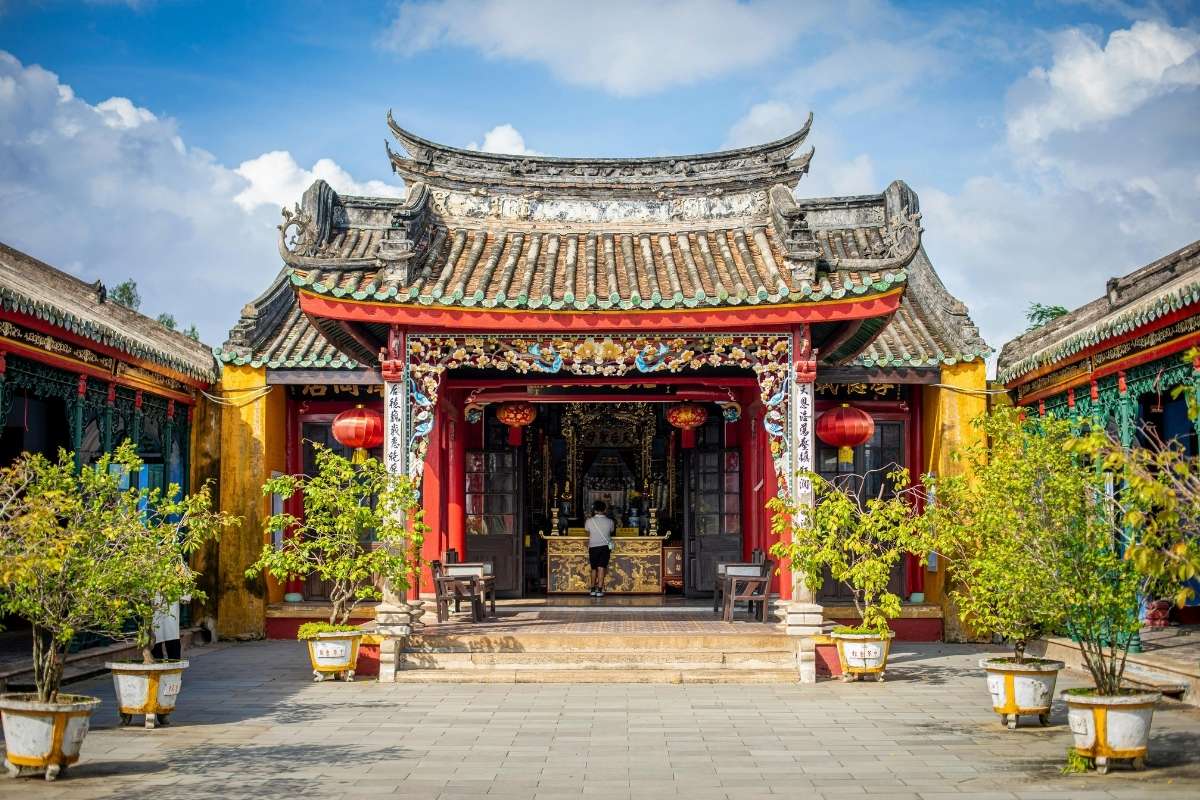
Exploring a Hoi An pagoda is most rewarding when you move slowly, dress respectfully, and treat each site as a living place of worship. A thoughtful route can combine temples, rice fields, cafés, and Old Town heritage in one gentle day.
- Dress modestly: Cover your shoulders and knees before entering pagodas in Hoi An, especially active Buddhist halls and community shrines.
- Remove shoes: Take off your shoes when entering temple interiors, prayer halls, or raised sacred spaces where local worshippers do the same.
- Lower voices: Keep conversations soft because many Hoi An temples still serve monks, caretakers, and local families during daily worship.
- Bring cash: Carry small notes for donation boxes, incense offerings, parking fees, or simple refreshments along countryside temple routes.
- Respect photography: Check signs before taking photos, avoid flash near altars, and never interrupt people praying or making offerings.
- Plan routes: Pair Old Town sites with cafés, then cycle toward Chuc Thanh, Phuoc Lam, Van Duc, or nearby rice fields for a quieter spiritual trail.
Where Should You Stay to Experience Hoi An’s Spiritual Side in Comfort?
After incense-scented courtyards, carved altars, and quiet temple paths, what you truly want is calm that continues beyond the visit. La Siesta Hoi An Resort & Spa offers luxury eco-friendly retreat accommodations in Hoi An and has earned Travelife certification for sustainable accommodation after an independent audit.
La Siesta serves travelers seeking reconnection with family, partners, nature, and themselves, pairing heartfelt hospitality with restorative space and seamless access to the Ancient Town. The resort provides a serene environment with shuttle support, complimentary bicycles, wellness facilities, lush gardens, and onsite services designed to ease city stress.
Recognised among the Top 3 hotels globally in 2024 in TripAdvisor Travelers’ Choice recognition, La Siesta Hoi An Resort & Spa brings spiritual discovery back to green comfort. Step away from the noise, follow Hoi An’s sacred stillness, and let La Siesta welcome you home after every meaningful discovery.